Local Hero Awards - Santa Barbara
Edible Santa Barbara wants you to join them in celebrating the Heroes of the Santa Barbara local food community.
Labels: Edible Santa Barbara, farmers, Farms, local, Santa Barbara
| Permalink | 

Labels: Edible Santa Barbara, farmers, Farms, local, Santa Barbara
| Permalink |
Joel Salatin is heralded as the high priest of the pasture. And for good reason. The Virginia farmer speaks the gospel of local, clean, and healthy eating. No pesticides. Uber-organic. Just a man and his earth—with as little government interference as possible. Devotees are eating it up.Now, he’s out with a new clarion call for a nation of unhealthy eaters: Get off your laptop and get your hands dirty. Get close to the earth. Understand where your food and fuel comes from. Before it’s too late. - OnPoint Radio
Labels: farmers, Farms, Joel Salatin, Organic
| Permalink |
SBAFA Presents the Farm to Fork Series, Mar. 23 & Apr. 6
The Santa Barbara County Ag Futures Alliance (AFA) is proud to announce the kick-off to their agricultural education campaign, Agriculture in Santa Barbara County: The Field to Fork Series. The goal of the four-part series is to inform and educate local residents about food and farming practices in the County, looking at agriculture from the production, processing, distribution, and consumer perspectives, among others. Four local experts: Cathy Fisher, Santa Barbara County Agricultural Commissioner; Victor Tognazzini, Gold Coast Packing, Santa Maria; Robert Abbott, Hilltop and Canyon Farms, Carpinteria; and Dr. Neil MacDougall, Agribusiness Professor at Cal Poly, SLO, will provide the audience with background on issues related to and affecting agriculture. Topics will include local agricultural statistics, farming in today’s economic climate, regulatory realities, environmental resources and considerations, and the future of farming, among others.
The 4-part series will kick-off Wednesday, March 23rd from 6-8pm at the Faulkner Gallery in the Santa Barbara Public Library, Central location and again on Wednesday, April 6th from 6-8pm in Shepard Hall at the Santa Maria Public Library.
Download the press release (pdf) for additional details.
Labels: farmers, Santa Barbara
| Permalink |
 which is boosting California pistachio sales. Did you know that 98% of U.S. pistachios come from the Golden State?
 California pistachio growers are finding themselves the unexpected beneficiaries of U.S. trade sanctions against Iran. A U.S. ban on Iranian pistachios went into effect on Wednesday, as the Obama administration ratchets up economic pressure on Iran to open its nuclear facilities to international inspection. President Obama signed the ban on July 1. It's good news for American pistachio farmers, who have long vied with Iran for dominance in the U.S.'s $700-million domestic market, as well as overseas. And it's particularly welcome for Golden State farmers, who are in the midst of harvest season. - LatteTimesI, myself, am partial to our local growers Santa Barbara Pistachios. I pick them up at our Farmer's Market pretty much every Saturday. (Yes...I gobble them up that fast..) My favorite? The Chile Lemon!
Labels: California, California Agriculture, farmers, obama, pistachios, Santa Barbara
| Permalink |
 Join Edible Santa Barbara for a special screening of "Ingredients: The Local Food Movement Takes Root"
 Thursday, September 23
7:00-9:00pm
Faulkner Gallery, Santa Barbara Library
40 E. Anapamu, Santa Barbara
$10 Suggested Donation
A benefit for the 1st Annual Sol Food Festival on October 2nd
Labels: Benefit, Edible Communities, farmers, locavore, Movie, Santa Barbara
| Permalink |
August 1st, 2010
"DIG IN! A FARM FRESH DINING EXPERIENCE"
Proceeds to benefit Sol Food Festival.
Location: Shepard Farms
Cost: $75 per person includes 5 course meal, live music, farm tour.To RSVP email: info@solfoodfestival.com
*****************************
Monday, August 2nd, 2010
Sol Food Potluck and Farm Tour
Interested in supporting the Sol Food Festival? Join us at Orella Ranch on the Gaviota Coast for a night of local food, conversation and learning about the Sol Food Festival. We'll also learn more about Orella Ranch's sustainable agriculture programs. http://www.orellaranch.com
Location: Orella Ranch
Cost: FREE
RSVP: roots@loatree.com
Labels: Carpinteria, farmers, farming, Festivals, Gaviota, Sustainable
| Permalink |
You probably wouldn't notice it, but Southern California's avocado trees definitely do ---- the water is getting saltier. And the trend poses yet another challenge to the region's avocado growers, who for years have struggled with the rising price and reduced supply of water.
Avocado trees stressed by excessive salt produce smaller fruit, said Charley Wolk, an avocado grower in Fallbrook, a major center of San Diego County's $137 million annual avocado crop, about 40 percent of the state total. Smaller fruit reduces growers' income, because they're paid by weight and not the number of avocados they produce.
"As the blend gets more Colorado River water, we get more salt," said Wolk, owner of Bejoca Grove Management. "I think it's rather unique. The water meets the state's standard for human consumption, but it's not worth a damn for us to grow things." - North County Times
Labels: avocado, California Agriculture, farmers, Water
| Permalink |

It’s summertime and that means two things: 1) There are loads of delicious farm fresh produce available at our local Santa Barbara farmers market every week; and 2) American Farmland Trust’s America’s Favorite Farmers Markets™ contest has kicked into gear and we need your votes to win!
The process is simple. To vote for our market, all you have to do is:
1.) Go to www.farmland.org/vote
2.) Type in Santa Barbara ; and,
3.) Click “Vote”
That’s it. That’s all it takes to bring Santa Barbara Certified Farmer's Market one step closer to being America’s favorite farmers market!
According to American Farmland Trust (AFT), the purpose of this contest is to re-connect local consumers to local farms, with the ultimate goal of keeping our nation’s farm and ranch land productive and healthy! Buying at the farmers market keeps money in the local community and helps farms and ranches remain economically viable. By voting, you’re helping support farms and communities across the nation. As American Farmland Trust says, “No Farms No Food™!”
Labels: contests, Farmer's Markets, farmers, farming, voting
| Permalink |
Labels: Carpinteria, cooking classes, farmers, Farms, Santa Barbara, Shepherd Farms, Slow Food
| Permalink |
Labels: farmers, Farms, Food, Outstanding in the Field, YouTube
| Permalink |
California agricultural producers who are certified organic or transitioning to organic production, may qualify for technical and financial assistance through a special initiative administered by USDA's Natural Resources Conservation Service.Some $2 million in funding will be available to eligible producers in California as part of the agency's Environmental Quality Incentives Program. Organic producers must submit applications by March 12 for funding consideration during fiscal year 2010.
Noting that the EQIP deadline for most applicants was Jan. 15, District Conservationist Phil Hogan said the agency was allowing a bit more time for organic and transitioning producers to develop their conservation applications but stressed they should begin the process as soon as possible.
Hogan encourages organic producers and those transitioning to organic production to contact his office at 662-2037, ext. 111, and learn more about this opportunity before the March 12 sign-up deadline. - The Daily Democrat
Labels: California, California Agriculture, farmers, farming, Organic
| Permalink |
....The student’s garden is just one example of how Palmisano’s small plot of land has tendrils that reach beyond the fence. The school’s horticulture class comes out every couple of days to work in the gardens. Veterinary science students wheel their stable sweepings up to the compost piles each day. Most important, the produce from the garden travels across campus to the cafeteria, where it appears in the lunches served each day, and into the culinary classrooms where students use it in their recipes.
Cordeiro see the tendrils reaching far beyond even these relationships.
...Cordeiro sees the school’s organic garden as a small, but pivotal, component in a much larger game plan. He is directly responsible for educating Carpinteria public school students between the ages of 3 — the district has three pre-schools — and 18. But the studies are clear. The earlier you start with children’s education and diet, the better their chances are of living a healthy life, completing high school and going on to college.
And, the children cannot be considered in separation from their families.
“If the family is strained, then the student is strained,” Cordeiro said.
“The food aspect, where we’re focusing (with the garden and culinary programs now) now, has to get pushed back under the umbrella of wellness.”....The Carpinteria organic garden is partly funded through the s’Cool Food Initiative, an undertaking of the Santa Barbara-based Orfalea Foundation, which was created by Kinko’s founder Paul Orfalea and his wife, Natalie. According to foundation vice president Catherine Brozowski, Natalie Orfalea is the driving force behind the organizations.
...“This garden integrates our agricultural systems programs, our culinary programs, our cafeteria,” he said. “Orfalea helped us get gardens at our elementary schools. We just had the first farmers markets with produce from the schools.”- Noozhawk
Labels: Carpinteria, farmers, Food, garden, Kinkos, Orfalea, Organic, School Lunches, students
| Permalink |
Joel Salatin, fulltime family farmer of the highly successful Polyface Farms, and recipient of the Heinz Award for Environmental Leadership, is one of the world’s leading advocates of farming and food relocalization. Featured in Michael Pollan’s book, Omnivore’s Dilemma, and in the films FRESH and FOOD, Inc., Joel Salatin and Polyface Farms exemplify successful grass farming and the farming and food relocalization movement. Joel is the author of six books including Family Friendly Farming, Salad Bar Beef, and his latest, Everything I Want To Do is Illegal.
In this course, Joel will challenge participants to design pathways to relocalization based on his own very successful model at Polyface Farms in Swoope, Virginia, and will also include techniques and directions from the emerging relocalization movement.
Relocalization is a strategy to build societies based on the local production of food, energy and goods, and the local development of currency, governance and culture. The main goals of Relocalization are to increase community energy security, to strengthen local economies, and to dramatically improve environmental conditions and social equity. The Relocalization strategy developed in response to the environmental, social, political and economic impacts of global over-reliance on cheap energy. Our dependence on cheap non-renewable fossil fuel energy has produced climate change, the erosion of community, agricultural lands, wars for oil-rich land and the instability of the global economic system.
Carbon Economy Courses
Labels: Environmental, farmers, Farms, Omnivore’s Dilemma, Organic, Santa Barbara
| Permalink |
Click here to Vote for “Best Of Santa Barbara” in the following categories:
Labels: Chef, Edible Communities, farmers, local, locavore, magazines, Santa Barbara, voting
| Permalink |
| Permalink |
Stanford Hospital & Clinics is launching a new daily menu for inpatients featuring organic, locally grown, sustainable ingredients. Chef Jesse Cool's creative approach to developing a new menu option reflects a basic principle - simple is best. - Stanford's "Farm Fresh" program
While the country roils in debate over health care reform, Stanford Hospital and Clinics is reforming the in-patient experience one meal at a time through its new Farm Fresh project. Launched in a pilot phase last month, the program brings organic, locally grown and sustainable food to a setting better known for serving up Salisbury steak and Jell-O.
It's available to any patient whose doctor approves it, and does not cost a penny more than traditional fare. Other area hospitals have experimented with varied food options - Kaiser Permanente offers Northern California patients local, sustainably grown fruit, hormone-free milk and zero trans fat menus.
But Stanford Hospital administrators believe Farm Fresh is the first program of its kind, with a larger selection of organic, locally produced food for all meals and a focus on nutrition education designed to be used beyond the bedside. - SFGate
| Permalink |
A contest sponsored by GOOD, The Architect’s Newspaper, The Urban & Environmental Policy Institute, and The Los Angeles Good Food Network.
the OBJECTIVE
We want designers, architects, farmers, chefs, vendors, and farmers’ market shoppers to think about how good design can improve upon the modern farmers’ market experience.
the ASSIGNMENT
Design a new venue, product, distribution method, or marketing mechanism that increases both financial returns to farmers and access to healthy foods for consumers of all scales—from the home cook to food service chefs. Innovations should help small family farmers bring good food to market and/or provide consumers access to good food.
the REQUIREMENTS
By September 1, 2009, send us an email at projects[at]goodinc[dot]com with the following:
—At least one image: sketches, drawings, three dimensional renderings, scaled technical drawings, photographs, altered photographs. Your images do not need to be high res to submit to GOOD, but you must have high res images ready for printing and/or publication should we want to publish and print yours.
—A brief narrative, up to 500 words, that explains how the design enables food production and/or delivery methods that support both the needs of small- to mid-sized family farmers and/or distribution to urban residents.
—Your name, city, and local farm or farmers’ markets.
More at GOOD.
Labels: contests, Farmer's Markets, farmers, farming
| Permalink |
Labels: Farmer's Markets, farmers
| Permalink |
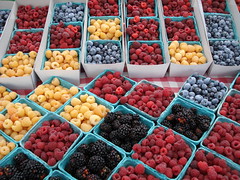
The US Secretary of Agriculture Tom Vilsack has declared that "farmers markets are important nationwide outlets for agricultural producers," and that thousands of markets "across the country offer consumers affordable, convenient, and healthful products sold directly from the farm in their freshest possible state, and so...." August 2-8 is National Farmer's Market Week!
Labels: Berries, Farmer's Markets, farmers, Santa Barbara
| Permalink |
Since its adoption 44 years ago, the California Land Conservation Act, popularly known as the Williamson Act, has grown into the state's most important farmland protection program. The Williamson Act has served California very well, but it is facing its most significant challenge due to the ongoing state budget crisis.
In addition to protecting one of our state's most valuable resources—our agricultural land—other significant benefits of the act must also be recognized and appreciated for their contribution to our quality of life: the protection of our precious watersheds; the availability of and access to a local, safe and affordable food supply; wildlife habitat; and the beautiful landscapes that are so important to all of our citizens.
...In addition to its significant impacts on the state and local economies, the Williamson Act is widely appreciated by those in the environmental, agricultural and business communities, as well as by state and local government officials, as one of the most important environmental laws ever adopted in California. It has encouraged good land use planning and prevented leapfrog developments that can be devastating to agricultural and natural resources.- California Farm Bureau Federation
Program benefiting farms and ranches gutted.
...Under the Williamson Act, landowners sign 10-year contracts with the county that allow ranchers and farmers to pay property taxes based on what they produce on their land, instead of charging them the same taxes residential landowners pay.
The state then reimburses the counties the difference.
As a result, county governments - not farmers - will initially see the effect from the funding cuts, said Assemblyman Jim Nielsen, R-Gerber.
..."That's discretionary dollars," Lees said, meaning the money can be used for just about anything.
Bundy said most ranches and farms under Williamson Act protection might be temporarily safe from drastic tax increases because of the 10-year contracts. But he was quick to add that he didn't know for sure.- Redding.com
...Farmland preserved by the Williamson Act takes more of the world’s primary greenhouse gas — carbon dioxide — out of the air than any other program now contemplated. More than the proposed tailpipe emission changes and carbon-trading programs proposed as ways to carry out the landmark 2006 AB32, the most aggressive anti-climate change bill ever passed anywhere. More than scrubbing every smokestack in California. More than all proposals to clean up ship- and truck-caused emissions from all California’s ports put together. - Ventura County Star
Now, more than ever, we need to support our farmers...our farmland...our open spaces our environment... because they are endangered more than ever.
Labels: Agriculture, budget, California Agriculture, farmers, farming, Farms, Governator
| Permalink |





My blog is worth $12,984.42.
How much is your blog worth?


