Tuesday, April 20, 2010 

Whole Foods Santa Barbara

a "shining" example of energy efficiency.
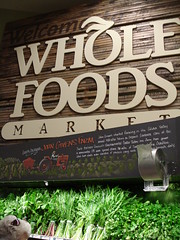

Whole Foods Santa Barbara
Originally uploaded by santa barbarian.

Supermarket chain Whole Foods has set a goal to reduce energy consumed per square foot 25 percent by 2015.

Additionally, the chain said it is stepping up efforts in the areas of wind energy, on-site renewable energy, and aggressive green building, advanced refrigeration and transportation practices, according to a press release.


Whole Foods points to its Santa Barbara, Calif., location as one that couldprovide an example to others. That store uses 45 percent less energy than a comparable store nearby. - Environmental Leader
Whole Foods has been working with the National Renewable Energy Laboratory as part of a Retail Energy Alliance partnership with the US Department of Energy to test and develop more efficient buildings.

The aim of that work is to design a building that is 50% more efficient than current efficiency codes require. -
Brighter Energy

Labels: , , ,

Monday, July 27, 2009 

"Carmelized" Energy...brings tears to my eyes

I had no idea that onions could produce juice...of the energy type. Looks like Gills Onions is crying all the way to the bank with their new energy recovery system. Perhaps they will be running "rings" around the competition!

Gills processes as many as a million pounds of onions a day at its Oxnard facility, which employs about 400 people and is the largest onion processor in the country. Its daily work generates about 300,000 pounds of onion waste, but a new energy recovery system at Gills turns what was once thrown away into clean heat and electricity and valuable cattle feed. The system generates 600 kilowatts of electricity.

“It’s a hard pill to swallow, but it’s been one my goals for my whole life to take care of this waste,” Gill told the Business Times.

Gill’s investment will pay for itself in about six years. The plant has been online for a few weeks, and once he proves it works, he’ll get a $2.7 million check from the Southern California Gas Co., which is administering money from a state program designed to encourage big users to generate their own energy.

Before the new fuel-cell plant, Gills put its waste out onto fields, where it generated carbon dioxide and methane as it decomposed. The process also cost a lot of money in diesel fuel to transport the waste, tipping fees to dump it and labor to spread it. Turning the waste into energy instead will save the company $700,000 in electricity costs, $400,000 in land-application costs and reduce its greenhouse gas emissions by up to 30,000 tons annually.

...Gills Onions is in the midst of a host of other green-minded activities. It recently signed on with the California Climate Action Registry and is gathering information for a baseline measure of its greenhouse gas emissions.

Once that baseline is complete, the public will be able to view it along with improvements the company makes. Oxnard-based Agromin is a member of the group, as are the cities of Thousand Oaks, Ventura and Santa Barbara. Gills is also working with the Bren School of Environmental Science and Management at the University of California, Santa Barbara. Four graduate students there are working with the firm on drawing up a plan to make Gills Onions a zero-waste company. - Pacific Coast Business Times

Labels: , , ,

Tuesday, June 16, 2009 

Whole Foods Market

Is #5 on the list the top 25 Green Energy Leaders as ranked by the EPA and published in Scientific American.
It is no longer enough to just conserve energy. More and more corporations, government agencies and entire cities are making large, long-term commitments to ensure that the power they do use comes from renewable sources. To recognize these trendsetters, the U.S. Environmental Protection Agency publishes a quarterly list of the top American users of green power: organizations that generate their own renewable energy, buy it from suppliers, or purchase offset credits to compensate for their traditional energy use. To put things in perspective, the average U.S. home consumes about 10,656 kilowatt-hours (kWh) of electricity a year. That means number 25 on the list buys enough green energy to power more than 14,000 homes...

5. Whole Foods Market
Austin, TX | Retail
527 million green kWh, 100% of total power used
Since December 2005 Whole Foods Market has entirely offset conventional power consumption at its stores nationwide. At that time, its buy was the biggest renewable energy purchase ever in North America. Employees at the regional or store level determine what kinds of energy to purchase (or generate) for the most locally sound decisions.

Labels: , ,

Saturday, January 03, 2009 

Santa Barbara Wine Country

should invest in this new machine!
If you're done drinking for a while, why not turn your extra libations into fuel? Rachel dornhelm explores a machine that turns alcohol and sugar waste into food for your car, and whether it can save you money over the long haul.

...Customers who buy a machine can be hooked into a local supply network. They might get leftover wine from Northern California, or beet sugar waste from Nebraska. The machines won't be available until the end of the year, but Quinn says he's had thousands of orders. - marketplace

Labels: , ,

MY INGREDIENTS

  • I'm SantaBarbarian
  • From Santa Barbara, California, United States
Recipe of Me

Click for Santa Barbara, California Forecast


Local Food and Local Farms

www.flickr.com
This is a Flickr badge showing public items from santa barbarian tagged with Food. Make your own badge here.
Help end world hunger

LOCAL LINKS